Learn to Hold Space for Grief in Community Circles
grounded in 15 years of expertise · trauma-informed · practice proven
for your teams, networks, friends and community events
Online-Training
in a small group with only 16 people
15. October 2026 bis 18. Februar 2027
5 Months
7 x 3-4h Group-Calls
+ One Personal Supervision-Session for You
For Everyone Who Wants to Open Spaces for Collective Grieving
Therapists, activists, organizers, team leaders, facilitators, educators, networkers, and more
To Offer Solace and Strengthen Belonging and Collective Resilience
in Times of Personal and Collective Crises and Losses
Large multi-day grief rituals like our Grief Fires are essential in these times, yet they require a wide range of skills, a high level of commitment, and a lot of time from everyone involved.
In everyday life, we also need smaller formats that are (relatively) easy to facilitate and can fit into already full calendars.
With a grief circle, you can offer relief, strengthen connection and belonging, and help participants find renewed courage to live – even in very difficult times.
In this training, you learn what it takes to open a shared space for grief in your professional, personal, or activist contexts – in a clear and specific format: the grief circle.
You will complete the program with a certificate in Grief Circle Facilitation.
We prepare you to:
You receive:
Our approach to grief work is:
After the training, you can stay connected with us and our network of alumni, continue to share questions and challenges and get support from us. Together we can foster grief expertise as the essential cultural competence it really is – so that grieving can be met with more welcome, encouragement and support in our societies.
This training is especially for you if you work with groups of people who are facing personal or collective distress, loss, or crises.
You might be a:
We can say with confidence that even in a Zoom call it is possible to create a safe, nurturing, and genuinely fruitful space between us, where we can work through content, reflect together, and even find deeper connection with one another — including for actual grief circles.
Most important for this to work: you need to keep the whole session free and be in a place where you will not be disturbed, or at least be able to shut out what is happening around you with headphones, so that we can really share a common space during the live calls.
You also need a stable, strong internet connection plus a smartphone or, even better, a computer to join from.
During the call, you do not need to focus on the screen the entire time. You are very welcome to:
Whatever helps you stay present and relaxed is exactly right.
You can also switch to another room, change your seat, or move your laptop or phone from time to time if that feels helpful.
We will also be working with:
In an emergency, for example in case of illness, an accident, or pregnancy, you can listen back to all the content at home via recordings.
You can also follow up on the exercises together with your training buddy, or with people from your home context, using our event script as a basis.
Building a solidarity-based, equitable society is, for us, one of the two most important tasks of our time — the other being a life-nourishing relationship with the more-than-human world.
We see this as a collective process that needs all of us. Many of us have been socialized in a profoundly unequal society and have internalized different forms of discrimination. As a result, we often reproduce these patterns unconsciously through distorted ways of perceiving, thinking, and behaving. We see the repeated, conscious dismantling of these patterns of dominance and dehumanization — and their gradual replacement — as a crucial part of this process.
As an organization, we have also been in a learning process for several years. This means we cannot promise a space that is 100% free of discrimination. But we take feedback seriously, work to reduce discrimination within our events through solidarity-based facilitation, and keep questioning ourselves along the way. We also seek support from external experts, such as anti-racism and power-awareness specialist Evein Obulor, who supports and supervises us.
You can read our continuously evolving awareness / anti-discrimination concept here.
Our approach to grief work has grown primarily out of many years of practical experience and learning by doing. The central entry point for us came directly through the work of Sobonfu Somé, who grew up in Burkina Faso in West Africa and as long as we knew her spent roughly half of each year there.
For several years, Elke hosted Sobonfu’s ritual workshops, created a framework around them and increasingly helped facilitate them. From Sobonfu’s perspective, allowing grief and actively grieving was not optional, but a recurring necessity in order to remain connected to inner aliveness and to other people despite heavy losses — and also in order to act peacefully as a society.
After her death in 2017, we began to develop and cultivate our own ways, forms, and formats for communal grieving. To do this, we combined Elke’s practical experience with communal grief and the perspectives inspired by Sobonfu Somé with current insights from Western psychology, neuropsychology, and Western grief-support theory and practice.
Our purpose is to use this combination to develop and practice truly helpful, trauma-sensitive ways and forms of grief process facilitation for here and now. By now, we have been able to create communal grieving spaces for many hundreds of people and have already trained more than 80 people in our approach to community-based grief process facilitation.
Sobonfu Somé developed the rituals she led for workshop groups in Turtle Island/the USA and Europe specifically for a Western context and deliberately left out many cultural elements, viewpoints, symbols, and practices from the start. Since Elke was the organizer of her grief rituals and other offerings here in Germany, in addition to experiencing the practice itself, she was also able to have countless conversations with Sobonfu about why she did certain things. Most of the time, Sobonfu was here with us twice a year for almost two weeks. During those visits, Elke spent countless hours with her, discussing how we could support Western-socialized people in general — and our specific participants and the people in our large volunteer teams — in strengthening their relationship to grieving, ritual work, and ultimately to the web of life.
Decolonial development for all was and is the central point
At its core, this to us never seemed to be about making life even more comfortable for Western, mostly white people. Rather, the intention we understood behind Sobonfu’s work in the West was to address the roots of the harm caused by ongoing colonial violence. Sobonfu’s homeland was and is itself massively affected by different forms of colonial exploitation, oppression, and destruction. She herself and her elders at home saw one major driver of the many obvious and subtle forms of this violence in something that is largely missing in the Eurocentric and Western world: deep, emotional access to our more-than-human world and to the experience of real belonging and safety within living, supportive community — and all of that in our full humanity, just as we are.
Those violent lies of racism, white „supremacy,” and the forced extraction from nature that emerged from parts of Europe are only a few centuries old. Their still seemingly unstoppable spread has been and remains linked to the reality of many people whose roots to land were systematically severed or left to wither. Connected to this is a lack of lived experience of being part of the larger community of life. And for many, there is also a lack of loving, affirming, and at the same time open-hearted, inclusive human community.
In all of our conversations Sobonfu was very clear that none of these enormous losses could be adequately addressed without community-based grief work. As we understood her, communal grieving spaces are a prerequisite for peacefully processing painful life experiences in general — and especially the losses, shame, and systemic (psychological) violence to which people in Western contexts have been subjected for many centuries. She frequently named community-based grief work as an essential ingredient for ending the cycle of (colonial) violence spreading into nearly every corner of the earth and for creating a more life-giving way of living together.
Sobonfu’s perspectives and her attitude were shaping Circlewise profoundly, right from the beginning. It was a great blessing and good luck, really, that Elke was able to learn side by side with her during that time, in close exchange about everything we did together, until Sobonfu died in 2017 after a serious illness.
During the years with Sobonfu, Elke herself was able to shape much of the framework, methods, and increasingly also the content around Sobonfu’s rituals through “Verbindungskultur,” with a great deal of emotional and practical support, especially from Judith Wilhelm and Julie Langhorne. Since then, Elke and Noraa have continued to develop this work – always with loads of support by our teams of volunteers and by the genuine experiences and feedback from all our participants.
Navigating respect and reciprocity
As white people learning from an Indigenous teacher, we are confronted with big and uncomfortable questions. How can we share from the experiences we have been able to make in a way that honors and supports Sobonfu’s core concerns, but without ultimately reproducing colonial exploitation?
This is a question that is continually accompanying our work at the Circlewise Institute.
Our current approach is as follows:
On the origins of talking circles as a method
Another key aspect of our grief circles in particular goes back to the practice of talking circles. When talking circles are practiced, people often point out that humans in earlier times must everywhere have gathered in circles like this. This is certainly true in many respects, and for example there have been circular gathering places on the European continent for many thousands of years. But the specific form of passing a talking object around, which has been used for many years in countless contexts in Europe as well — from kindergartens to far-reaching Restorative Justice projects — clearly comes from Indigenous traditions in Turtle Island/the USA and Canada and has been and is taught there by specific people and communities from there.
Failing to name this means not honoring Indigenous knowledge and its concrete influences, but rather making them invisible — a sadly still common practice of colonial exploitation. By withholding visibility, the flow of recognition, reputation, and ultimately material appreciation is also prevented from the outset.
In our grief circles, we consciously do not use cultural symbols from Turtle Island cultures. Nevertheless, the basic form, including the use of a talking object, is based on parts of that knowledge, specifically the knowledge taught by Harold and Phil Gatensby of the Carcross-Tagish and Dahka T’lingit First Nations in the 1990s and still taught today. The Gatensbys were survivors of the horrific boarding school system, and looked for ways to change the justice system, the juvenile justice system, and also the school system so that the massive racist structural violence against Indigenous people — still ongoing today — could be reduced. This violence, among other things, causes an incredibly high percentage of First Nations people to spend long periods in prison even for minor offenses, immensely reducing their chances to build a free life and livelihood for themselves, their families and communities.
To this end, the Gatensbys and other teachers deliberately trained many non-Indigenous people in Turtle Island to lead talking circles, in order to make community, belonging, and peaceful conflict resolution more possible. During this time also white authors such as Kay Pranis and the then judge Barry Stuart were given access to the knowledge and practice of circles. Together with Mark Wedge (Carcross/Tagish First Nation), they wrote the book Peacemaking Circles – From Conflict to Community (published by Living Justice Press), which describes the use of talking circles in detail and with many variations, especially as part of the justice system within Indigenous nations in Turtle Island, but also with recommendations for practicing them in other contexts. Our understanding of talking circles at Circlewise is also based largely on this book.
Recognition paves the way to reciprocity
We believe that talking circles, even when done with only a few of their original elements, have immense value for our work and certainly for all of the many Western contexts in which they are used today. They are now so widespread in Western contexts that even a small amount per circle could already amout to a meaningful support for community projects. Because appreciation needs more than words, we have started to give a portion of our income back, specifically to the Native American Rights Fund, which among other things funds the Indigenous Peacemaking Initiative. This network of judges and other practitioners trains and advises a growing number of communities in Turtle Island to implement and recover traditional peacemaking processes.
Yes, if you are interested in learning from a person with an actual Indigenous background, you might want to check out Tobi Ayé, a descendant of Nago/yoruba people of West Africa, currently based in Portugal. Tobi is an educator, facilitator, ceremonialist and artist working with grief and trauma through indigenous and vernacular ways of knowing and she teaches grief facilitation through her Collective Resonance Training that is also available online.
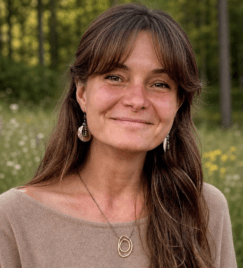 (she/her)
Elke is the founder of Circlewise and works like a kind of gardener for social spaces. She has been exploring, developing, and practising the art of weaving social and inter-species connections for over 15 years in many different settings.
She speaks English as her second language, is positioned as a white, able-bodied, neuro-divergent mother, born and raised in socialist Eastern Germany before, during and after the fall of the wall, is trained as a counselor and Somatic Experiencing® Practitioner, a body-based trauma approach developed by Peter Levine. In her work, Elke tries to bring together Western scientific insights with a power-aware, anti-oppressive perspective – inspired especially by voices from Indigenous communities (such as Sobonfu Somé), as well as from queer-feminist, Black, and People of Color movements.
You can learn more about Elke on our team page.
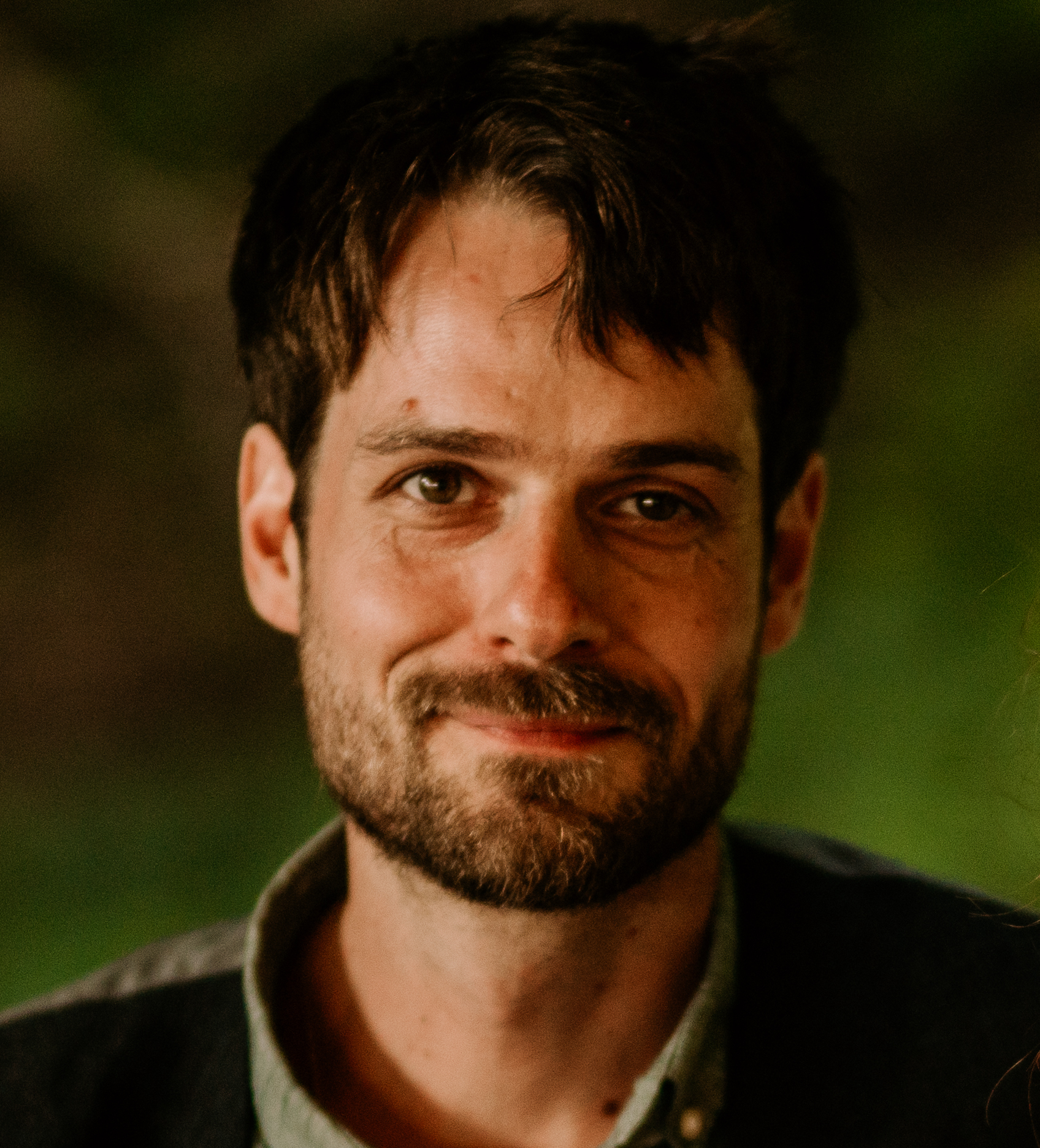
(they/no pronouns)
Noraa has been co-director of the Circlewise Institute since 2019 and has many years of experience accompanying a residential group for people with disabilities. They are a Somatic Experiencing® Practitioner, which is a body-based trauma approach developed by Peter Levine.
Living disabled with severe chronic illness and neuro-divergence, Noraa accompanies people through personal and collective processes of crisis and transformation with loving attentiveness, empathy, compassion, and a warm sense of humour. Their guided mindfulness meditations, nervous system co-regulation practices, and music – rooted in deep, authentic connection with life – touch and inspire people in lasting ways.
English is their second language. You can learn more about Noraa on our team page.
We meet online on Thursdays (Central European Time, Berlin/Amsterdam):
One 1:1 supervision session with us for you personally is also included.
Our pricing system follows a solidarity principle: it is designed to make this training more accessible to structurally disadvantaged groups.
You now have the chance to book until September 20th to secure our Early Bird price. You can use the following code during the bookingprocess: BIRD26
Your employer might be willing to support or cover this training – it could be worth asking.
In exceptional cases, instalment plans are possible by arrangement from the time of registration.
For more equitable participation, we support Black, Indigenous and People of Color with free or strongly reduced places in this training through our RISE Fund.
RISE stands for Reparation, Involvement, Solidarity, and Empowerment – a concrete strategy to strengthen participation and agency for historically and currently marginalised communities.
You can support the fund with a donation, easily transfered via our online tool.
If you belong to one of these groups, you are warmly invited to just contact us.
With our work, we commit to making visible the many forms of historical and ongoing injustice, oppression, and exploitation – both in society and in ourselves – and to creating spaces where these realities can be addressed and transformed.
We aim to foster more safety, justice, freedom, and belonging for everyone, and we understand this as a continuous learning and development process. We welcome critique, suggestions, and feedback as part of this shared journey.
Here you can either log in via the booking system – or if this is currently not working, also via this link: REGISTRATION
Important Safety Note
Participation in this training cannot replace therapeutic support.
If you are experiencing anxiety, depression, or other difficult mental states, please know that you are not alone – and that professional help is available.
In Germany, you can find licensed psychotherapists and trauma therapists via professional directories, for example Somatic Experiencing therapists, maybe also in your region.
In acute and life-threatening situations you can also call the emergency number 112 and ask for an ambulance, doctor or other medical or psychological support.
There are also telephone counselling services available, that are mostly free of charge and anonymously, and further information for services in different countries and with different languages can be found in a list here.

 Rafael HeygsterTrauerkreis-Training Online
 Tom Dils
 circlewise 2025
